I like to call myself a “super bloomer.” You’ve heard of late bloomers, I’m sure. We’re the ones who finally figure out what makes our hearts sing a little later in life. To be fair, my heart did sing for my thirty years as a teacher—but then I retired.
Honestly, for a while, I withered. Then to my wonderment, I sprouted fresh and green again. So, I didn’t really bloom late, I rebloomed.
Something to Pass the Time
My path to writing wasn’t planned. I didn’t wake up one morning with a grand vision of being published or holding book signings. It all began during a time when the world felt like it had been turned upside down—quarantine.
The days were long, the news was heavy, and like so many people, I was looking for something to anchor me—to pick up my heartache and turn it into something worthwhile.
I made a list of all the things I’d wanted to do but never had the time: clean and organize all the house, read all the books I hadn’t read, learn to speak French, Italian, or Spanish, watch all the Masterclass videos I’d accumulated. It was a long list. At the very bottom of the list: Write
I thought back to one of my favorite teachers in middle school: Mr. Reale. One morning he passed out “personal ads” from the classifieds in newspapers. He gave us the entire period to write.
The next morning, Mr. Reale read my story aloud to the class. I buried my head in my folded arms until I heard sniffles from a few classmates. I lifted my head, amazed at the response. In that moment, I realized the power of words.
Mr. Reale told me I had a gift—but I left it unopened. Even in high school when I earned praise for assigned essays, I didn’t give it a second thought.
In college, I jumped around in majors and minors. I couldn’t decide. One of my friends said, “It’s a no-brainer, you’re a writer.” But the English major was closed so I chose Political Science from the very short list of open majors.
In the many decades that followed, friends told me that I should write a book—probably because I told longwinded stories at lunch. But I told myself I didn’t have time.
During quarantine, I had more than plenty of time—I had too much time—so I decided to give writing a try.
It was frightening at first. It was like being a kid again in school with a 30-minute timer ticking away. I didn’t know what to write.
I remembered the advice I’d given to my beginning writers in elementary school: Write Your Heart Out.
I had witnessed shifts, subtle changes in my students’ writing over the course of a year, but I had never experienced it myself.
Why not take my own advice?
I traced a big heart and listed experiences that I held dear, that hurt, that were unforgettable, my dreams of what I wanted to do someday, regrets and fears. I created a sunny side and a moon side of the heart with a crack down the middle—a crack that needed to be mended. I illustrated the heart using colored pencils and pens.
I read Brene Brown’s Atlas of the Heart.
In those first few weeks, I wasn’t “writing a book,” but I was writing from my heart. I jotted down little stories, vignettes, memories, dialogue I imagined between people who didn’t exist outside my mind. I had no plot—just the urge to put words down before the days swallowed me up in worry.
At first, I told no one. Not because it was a secret, but because I didn’t think it was anything worth talking about. So, I kept my expectations low and my laptop close. I thought of it as a harmless distraction, something to pass the time until life “got back to normal.”
The Shift I Didn’t See Coming
Somewhere along the way, something changed. I noticed that after I wrote—even after just thirty minutes—I felt lighter. The days didn’t seem quite so long—quite so heavy. Writing became one of the silver linings I found in the dark cloud that hung over all of us.
I looked back over my collection of random snippets of writing. I searched for puzzle pieces that might fit together. I mined for gold, for gems that might be meaningful to a reader.
My mind, which had been swirling with fear and uncertainty, found a little calm in shaping words into sentences, sentences into stories—into worlds where I spent time.
Writing became less of a distraction and more of a lifeline. I stopped thinking about whether my writing was “good” and started focusing on how putting my fingers on the keyboard and letting them fly made me feel: alive, curious, and strangely hopeful.
I think it was the moment I unknowingly crossed over from dabbler to writer. I began to read not just for pleasure—but as a writer. The more I read, the more I realized, I needed to study the craft of writing.
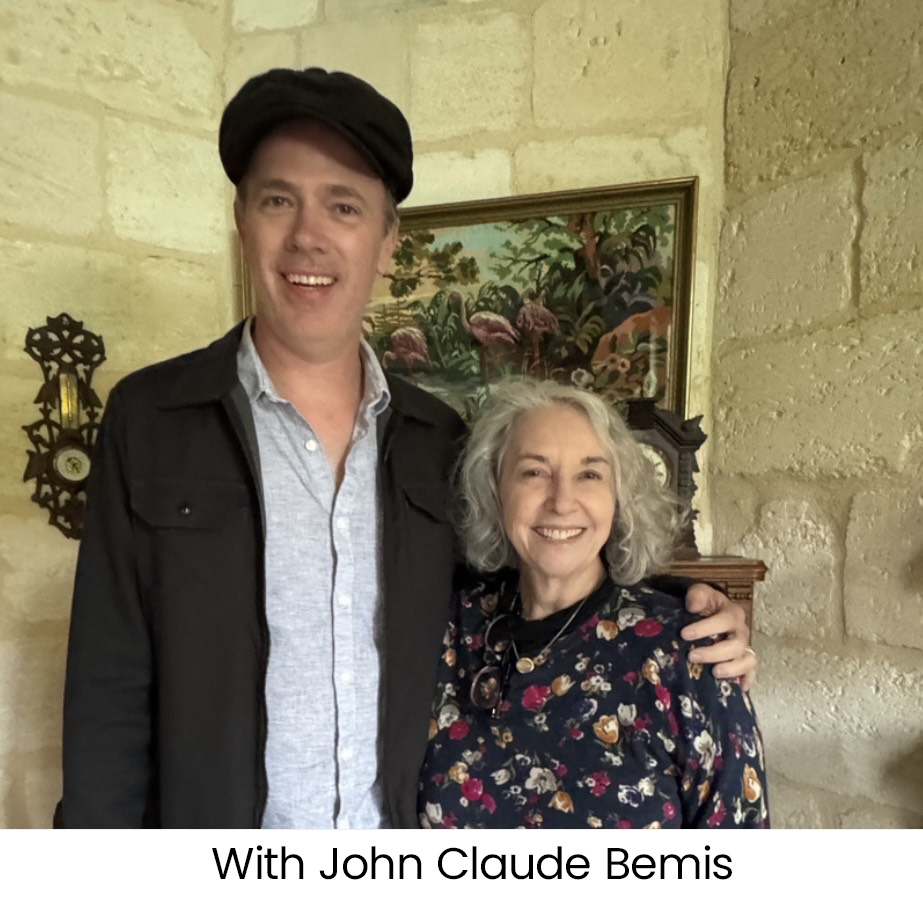
So, with a stroke of luck, I found an online class taught by the amazing John Claude Bemis. When I submitted one of my assignments, he complimented my writing with a phrase, I won’t share here for his privacy, but it made my heart sing. It set me free. It lit a fire of ambition.
The Battle with Self-Doubt
Of course, that doesn’t mean my self-doubt disappeared. Oh no, it moved in, unpacked its bags, and tried to redecorate my brain.
You’re too old to start something new.
Who do you think you are?
No one will ever read this.
Those were the whispers that followed me to my laptop. And for a while, I believed them. One day, I told them to go sit in the corner (I’d never had to sit in the corner, and I had never made anyone else do it), but I wanted my doubts to suffer.
Something magical happened: I improved.
Not overnight, and not without effort, but I saw progress. My sentences became sharper. My characters began to feel real. I could sense a rhythm in my writing that hadn’t been there before.
During our year of quarantine, I wrote 90,000 words. A lot of it was scattered, meandering, even drivel, but some of it sparkled with possibility.
Each small improvement felt like a victory—proof that it wasn’t too late for me after all.
I rebloomed big, wild, and unapologetically into a “super bloomer.”

 Virginia De Francisco